
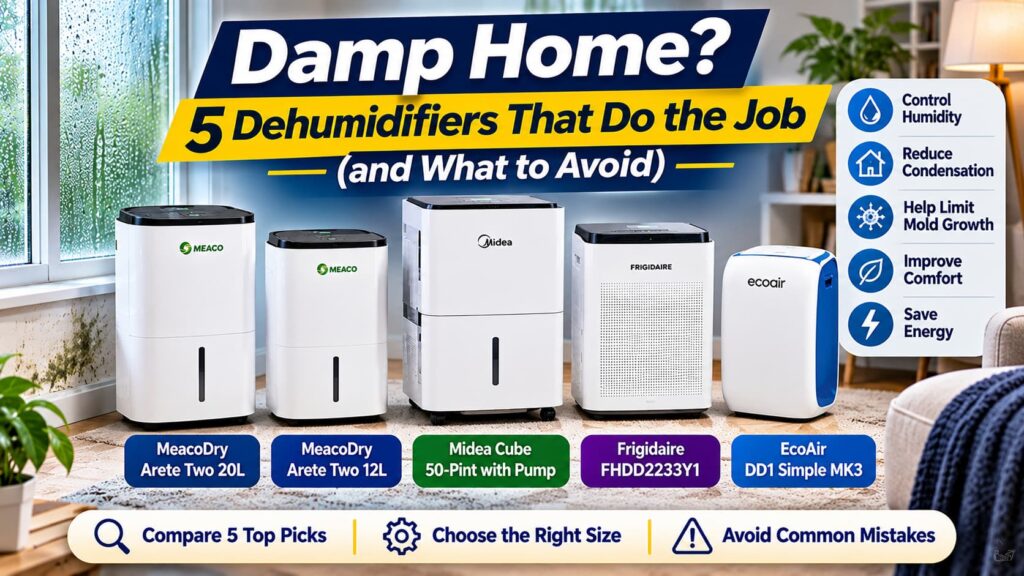

Condensation on windows, musty odors, damp walls and persistent indoor humidity can make a home uncomfortable. A suitable dehumidifier helps remove excess airborne moisture, but choosing the wrong model can mean higher electricity bills and disappointing results.
The best dehumidifiers combine suitable moisture removal capacity, manageable noise, convenient drainage and reasonable energy consumption. Our five selections cover everyday household use, bedrooms, larger basements, smaller budgets and cooler spaces.
However, even a powerful dehumidifier cannot repair leaking pipes or structural dampness. If moisture keeps returning, check for hidden leaks before relying entirely on an appliance.
Quick Answer: Which Dehumidifiers Are Worth Considering?
For general household moisture control, the MeacoDry Arete Two 20L is a strong option. The MeacoDry Arete Two 12L suits bedrooms and smaller homes, while the Midea Cube 50-Pint with Pump offers greater capacity for damp basements. The Frigidaire FHDD2233Y1 is a simpler, lower-cost option in the US market, and the EcoAir DD1 Simple MK3 is worth considering for cooler rooms.
These are five recommendations for different needs, not an independently calculated performance ranking.
5 Best Dehumidifiers at a Glance
| Dehumidifier | Best For | Moisture Removal Capacity | Key Feature | Main Consideration |
|---|---|---|---|---|
| MeacoDry Arete Two 20L | General household use | 20 L/day | Smart controls and laundry mode | Larger investment |
| MeacoDry Arete Two 12L | Bedrooms and smaller homes | 12 L/day | Low-speed noise from 35 dB | Lower capacity |
| Midea Cube MAD50PS1QWT | Large damp areas | 50 US pints/day | Built-in drainage pump | Bulky when extended |
| Frigidaire FHDD2233Y1 | Budget-conscious US buyers | 22 US pints/day | Continuous drainage | Less suited to severe damp |
| EcoAir DD1 Simple MK3 | Cooler rooms | 7.5 L/day | Desiccant technology | Heating element uses electricity |
Capacity figures are manufacturer ratings. European litre-per-day and US pint-per-day ratings can use different test conditions, so they should not be compared as equivalent measures of real-world performance.
How We Selected These Dehumidifiers
These five models were chosen through desk research using manufacturer specifications, product documentation and available independent evaluations. Selection criteria included moisture removal capacity, household suitability, operating noise, drainage options, humidity controls, maintenance and regional availability.
The shortlist gives priority to practical differences rather than marketing claims. Published specifications were considered alongside independent assessments, including product comparisons, where relevant.
This article does not claim first-hand testing. Categories describe editorial suitability, not laboratory performance rankings. The order is not based on a numerical score, and products with different regional testing standards have not been treated as directly equivalent.
1. MeacoDry Arete Two 20L — Best Overall Dehumidifier
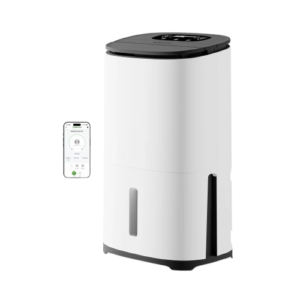
MeacoDry Arete® Two 20L Dehumidifier & Air Purifier
The MeacoDry Arete Two 20L is a compressor dehumidifier intended for households dealing with regular condensation and damp indoor air.
Its headline extraction rate is 20 litres daily at 30°C and 80% relative humidity. Under a more moderate 20°C and 60% humidity, Meaco reports approximately 8.5 litres daily.
Why it made the list: It combines substantial moisture removal with adjustable humidity controls, app connectivity and a laundry drying setting. A compatible HEPA filter can also be fitted for air filtration.
Best for: Medium to larger homes, busy households and rooms experiencing recurring condensation.
What to consider: It costs more than basic smaller-capacity models, and the compressor and fan remain audible during operation. Its European electrical specification also makes it unsuitable for direct use in every international market.
For buyers needing a versatile household appliance, the Arete Two 20L offers a useful balance of extraction capacity and everyday convenience.
2. MeacoDry Arete Two 12L — Best for Bedrooms and Quiet Spaces
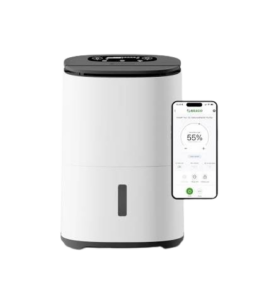
MeacoDry Arete® Two 12L – Smart, Quiet & Energy-Efficient Dehumidifier
The MeacoDry Arete Two 12L is a smaller compressor model suited to bedrooms, apartments and compact homes.
Meaco publishes noise levels starting at 35 dB and extraction rates of 12 litres daily at 30°C and 80% humidity, or 7.5 litres at 27°C and 60% humidity.
Why it made the list: Its relatively quiet low-speed operation makes it attractive for living spaces where background noise matters. Adjustable humidity control and smart features provide additional convenience.
Best for: Bedrooms, smaller homes and everyday condensation control.
What to consider: Low-speed operation does not mean silence. Compressor cycling, higher fan speeds and room acoustics affect perceived noise.
Its lower capacity also makes it less suitable for extensive dampness than larger units. The manufacturer’s UK page showed temporary stock limitations during the research review, so local availability should be checked before purchase.
Meaco (U.K.) Limited
3. Midea Cube 50-Pint with Pump — Best for Basements and Large Damp Areas
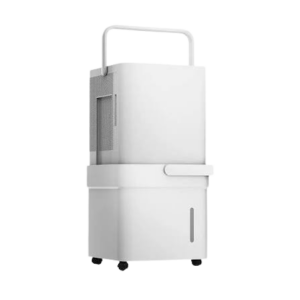
Midea 50 Pt. Cube Dehumidifier with Built-In Pump
The Midea Cube 50-Pint MAD50PS1QWT targets larger and more persistently humid spaces.
Its US-rated 50-pint daily capacity makes it a higher-capacity option, while its distinctive two-part construction supports both extended operation and compact storage.
Why it made the list: The built-in pump helps remove collected water without relying entirely on gravity drainage. This is valuable in basements where a suitable drain may be above the appliance’s outlet level.
Midea also provides smartphone controls for remote humidity monitoring and operation.
Best for: Basements, large utility rooms and spaces where continuous drainage would reduce manual maintenance.
What to consider: The extended design occupies more vertical space, and a full collection tank can be heavy. Buyers also need a suitable and correctly installed drainage route.
This is primarily a North American-market recommendation; other countries may require different locally certified models.
4. Frigidaire FHDD2233Y1 — Best Budget-Friendly Dehumidifier
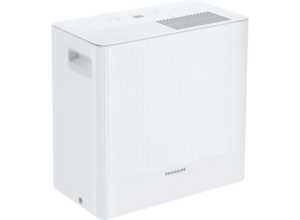
Frigidaire 22 Pint Dehumidifier in White – FHDD2233Y1
The Frigidaire FHDD2233Y1 offers a more modest extraction capacity for people who do not need an appliance intended for exceptionally damp spaces.
Rated at 22 US pints daily, it provides a removable water bucket, automatic full-bucket shut-off and a continuous drainage option.
Why it made the list: It concentrates on essential humidity-control functions rather than requiring buyers to pay for elaborate smart features.
Its wheels and carrying handle also make it easier to reposition within the home.
Best for: Smaller rooms, moderate indoor humidity and US buyers seeking a straightforward purchase.
What to consider: The lower extraction capacity may be insufficient for persistently wet basements or large connected spaces.
The budget-friendly designation reflects its simpler specification and lower manufacturer-listed price relative to larger models, not a verified global price comparison. Pricing and availability may change.
5. EcoAir DD1 Simple MK3 — Best for Cooler Spaces
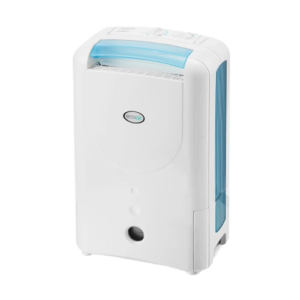
The EcoAir DD1 Simple MK3 differs from the other selections because it uses desiccant technology rather than conventional compressor-based moisture removal.
EcoAir advertises a maximum extraction capacity of 7.5 litres daily, making it worth considering for certain cooler indoor environments.
Why it made the list: Desiccant technology can perform more consistently than some compressor models in cooler conditions. Straightforward controls and a portable design add convenience.
Best for: Cool bedrooms, utility areas, seasonal properties and moderately damp rooms where temperature affects compressor performance.
What to consider: Desiccant units use electricity to regenerate their moisture-absorbing material. Their running costs can be higher than efficient compressor models in warmer conditions.
The DD1 Simple MK3 is not automatically the best energy-saving choice. Buyers should compare operating consumption with their expected daily use and local electricity costs.
What to Avoid When Buying a Dehumidifier
Buying the wrong dehumidifier can increase operating costs without adequately controlling moisture. These are the most important mistakes to avoid.
1. Choosing an undersized unit
A small dehumidifier may run almost continuously without reducing humidity sufficiently in a large or persistently damp room. Consider moisture levels alongside room size.
2. Trusting exaggerated coverage claims
Advertised floor-area coverage is not a guarantee of performance. Temperature, ventilation, dampness and moisture entering the room all affect results.
3. Confusing mini dehumidifiers with full-size appliances
Small thermoelectric models generally remove much less water than household compressor dehumidifiers. They are unsuitable substitutes for high-capacity appliances in severely damp rooms.
4. Overlooking water drainage
Check collection tank capacity before purchasing. Continuous drainage is useful when the appliance will operate for extended periods.
5. Ignoring electricity consumption
Compare operating power, expected usage and verified efficiency information. A cheap appliance may become expensive to operate regularly.
6. Expecting humidity control to repair dampness
A dehumidifier cannot fix plumbing failures, damaged roofing or rising damp. Addressing water damage requires identifying the moisture source and repairing affected areas where necessary.
How to Choose the Right Dehumidifier
Start by measuring indoor humidity with a reliable hygrometer. The US Environmental Protection Agency recommends keeping indoor relative humidity below 60%, ideally between 30% and 50% where possible.
Match capacity to the problem. A moderately humid bedroom requires a different solution from a basement with persistently damp surfaces.
Consider temperature. Compressor dehumidifiers commonly work well in normal household temperatures, while desiccant models can be useful in cooler spaces.
Evaluate noise. Compare published sound levels, but remember that manufacturer measurements may use different operating settings.
Check energy requirements. Consider actual electricity consumption and expected running hours rather than relying on general efficiency claims.
Plan drainage and maintenance. Ensure you can conveniently empty the tank, clean filters and position the appliance safely.
Finally, check electrical compatibility. North American 120V appliances and European 220–240V appliances are not automatically interchangeable. Choose the locally certified model appropriate for your country.
Frequently Asked Questions
1. What size dehumidifier do I need for a damp room?
The appropriate size depends on room dimensions, humidity, temperature and the amount of moisture entering the space. A smaller-capacity appliance may suit a bedroom with moderate condensation, while larger basements often need greater extraction capacity. Measure humidity and consider the severity of dampness before choosing.
2. Can a dehumidifier prevent mold?
A dehumidifier can reduce excess airborne moisture and help create conditions less favorable to mold growth. However, it cannot guarantee prevention or remove existing mold contamination. Persistent moisture sources, leaks and damaged materials must also be addressed to control the underlying problem.
3. How many hours a day should a dehumidifier run?
Running time depends on indoor humidity, the appliance’s capacity and the amount of moisture produced or entering the room. Models with adjustable humidity controls can operate automatically to maintain a selected level. Monitor humidity regularly rather than assuming continuous operation is always necessary.
4. Are expensive dehumidifiers always better?
Not necessarily. Higher-priced appliances may provide larger capacities, quieter operating modes, pumps or smart controls, but these features are not essential for every household. Compare extraction performance, operating costs, drainage, maintenance and room suitability. A correctly sized, simpler appliance may offer better value than an unnecessarily powerful model.
Final Thoughts
The best dehumidifier depends on the room, climate and severity of the moisture problem.
The MeacoDry Arete Two 20L is a strong general household choice, while its 12L counterpart suits smaller and quieter spaces. The Midea Cube 50-Pint with Pump is worth considering for larger damp areas, and the Frigidaire 22-Pint provides a simpler option for budget-conscious US buyers. EcoAir’s DD1 Simple MK3 offers an alternative for cooler environments.
Before buying, measure humidity, investigate persistent dampness and compare extraction capacity, electricity consumption and drainage requirements. Proper sizing matters more than choosing the appliance with the largest advertised coverage.
Editorial Disclosure
This comparison is based on publicly available information and editorial selection criteria. The display order is not an independently calculated performance ranking. Any sponsorship, affiliate relationships, paid placements or other relevant commercial arrangements must be confirmed and disclosed by the publisher before publication.